Structure of the courses C
Intermediate Course C: 3 - 4 days course
(18 - 24 hours)
Course Objectives
1. Advanced DNS assessment methods
- Deepen assessment of the sagittal stabilization patterns, locomotor stereotypes, and respiratory patterns.
- Apply DNS functional tests in more complex clinical contexts.
2. Muscle chain function in locomotion
- Analyze kinesiology of muscle chains in stepping forward, supporting function, contralateral and ipsilateral locomotor patterns.
- Integrate findings into clinical assessment and exercise prescription.
- Introduce high developmental positions in treatment.
3. Pelvic girdle and hip joint
- Understand phylogenetic and ontogenetic aspects of pelvic and hip development.
- Recognize anatomical parameters from a developmental perspective.
- Apply DNS assessment and treatment to common conditions: femoral-acetabular impingement (FAI), arthrosis and postural dysfunction.
4. Shoulder girdle
- Review phylogenetic and ontogenetic principles of shoulder function.
- Assess shoulder disorders (frozen shoulder, impingement syndrome, SLAP lesion, instability).
- Apply DNS-based strategies for both open- and closed-chain positions.
5. Spinal disorders
- Define ontogenetic aspects on spinal development.
- Identify most frequent spinal disorders (disc herniation, spondylarthrosis, spondylolisthesis, spinal instability), introduce assessment and treatment strategies.
6. Clinical reasoning and integration
- Develop advanced clinical reasoning to select and progress DNS treatment strategies.
- ntegrate DNS into everyday clinical practice, including multidisciplinary collaboration and patient education.
7. Progression in DNS education
- Prepare participants for the next level of DNS training – Course D (Prague)
Course goals:
- Understand developmental principles of the shoulder, hip, and spine
Master the role of these segments in supporting and phasic functions and their influence on posture and movement. - Perform DNS assessment of the shoulder, pelvis, hip joint, and spine
Learn to evaluate stabilization, joint centration, range of motion (ROM), and clinical movement patterns in both open and closed kinetic chains. - Apply fundamental DNS therapeutic principles
Be able to work with position setup, activation, controlled movement, and developmental patterns in both differentiated and undifferentiated variants. - Lead active exercise and load progression
Work with ipsilateral/contralateral patterns, transitional movements, and integration into functional activities under varying levels of load. - Integrate theoretical knowledge with practice and clinical decision-making
Analyze movement patterns, identify the patient’s key problem, and select an appropriate therapeutic strategy.
Course Program Overview:
Day 1:
Registration:
1.block: Developmental aspects of the shoulder girdle: influence of the thorax and scapula on shoulder function, basic mechanisms of the scapulohumeral rhythm, overview of common dysfunctions.
Break
2. block: DNS assessment of the shoulder girdle: examination in open and closed kinetic chains, quality of upper limb support, relationship between the shoulder and trunk stabilization.
Lunch
3.block: DNS therapy – principles and position selection: the 3 steps of therapy (position – activation – movement), management of clinical problems (soft tissues, joint play, stability, upper limb support).
Break
4.block: DNS active exercise – application: training shoulder and scapular centration in developmental positions, progressive loading (kneeling → bear → tripod → standing), dynamics, transitions, working with models/patients.
Day 2:
1.block: Developmental aspects of the pelvis and hip joint: pelvic function in relation to the trunk, basic pathologies, influence of thoracic and pelvic alignment on lower limb function.
Break
2.block: DNS assessment of the pelvis and lower limbs: specific tests (e.g., for FAI), DNS lower limb tests, morphological and functional parameters influencing segment centration and quality of support.
Lunch
3.block: DNS therapy – principles and patterns: position setup, activation, controlled movement; exercises in ipsilateral and contralateral patterns; modifications in developmental positions.
Break
4.block: DNS active exercise – application: training pelvic and hip centration, working with progressive load, integration into higher positions. Group exercise – “flow” through the developmental sequence.
Day 3:
1.block: ADevelopmental aspects of the spine and basic kinesiology: formation of spinal curves, importance of thoracic, pelvic, and hip positioning, overview of spinal dysfunctions.
Break
2.block: DNS spinal assessment and differential diagnosis: discogenic pain, facet syndrome, segmental instability, nerve root irritation, stenosis, radicular pain.
Lunch
3.block: DNS therapy – stabilization and clinical application: stabilization in various developmental positions, relief positions, traction, trunk activation, integration with hip function. Practical examples (3-month, 6-month, squat, lunge/ “knight position,” tripod, high kneeling). Discussion, Q&A
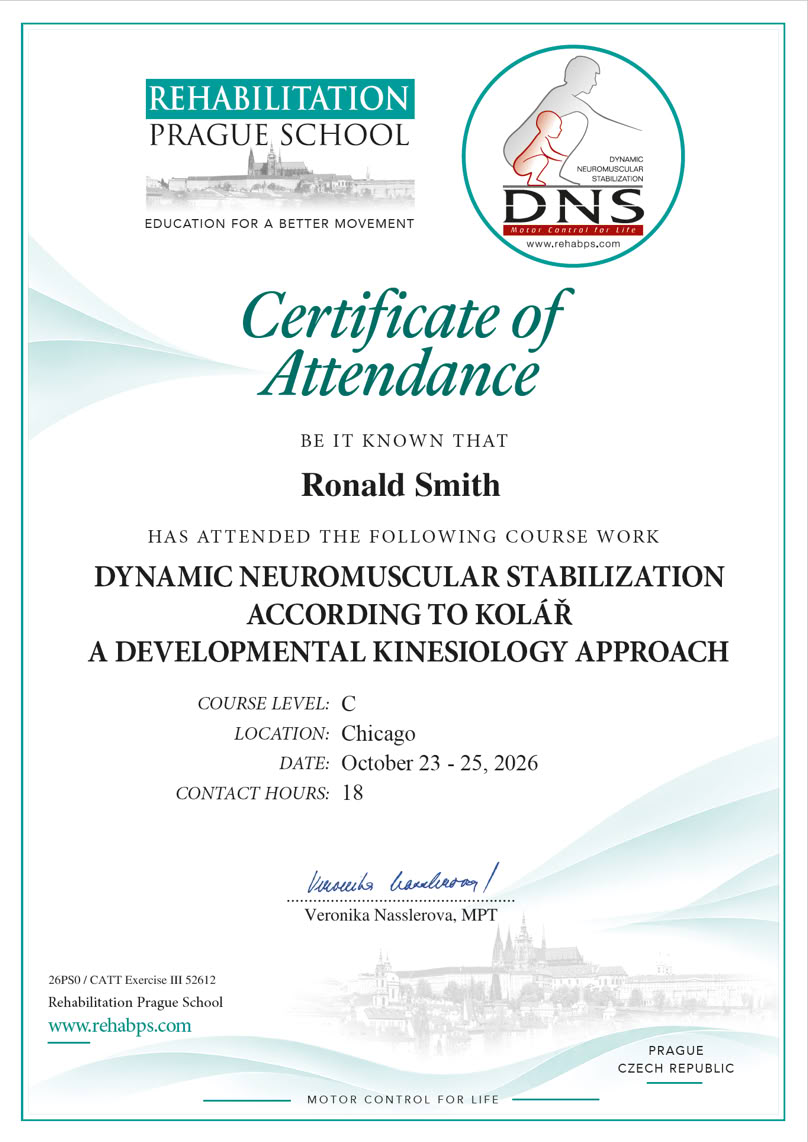
A Certificate of ATTENDANCE will be awarded by local instructor
OPTIONAL EXAMINATION
Participants who would like to participate in the educational track towards becoming a certified practitioner can take this exam for an additional fee of 150 Euros.
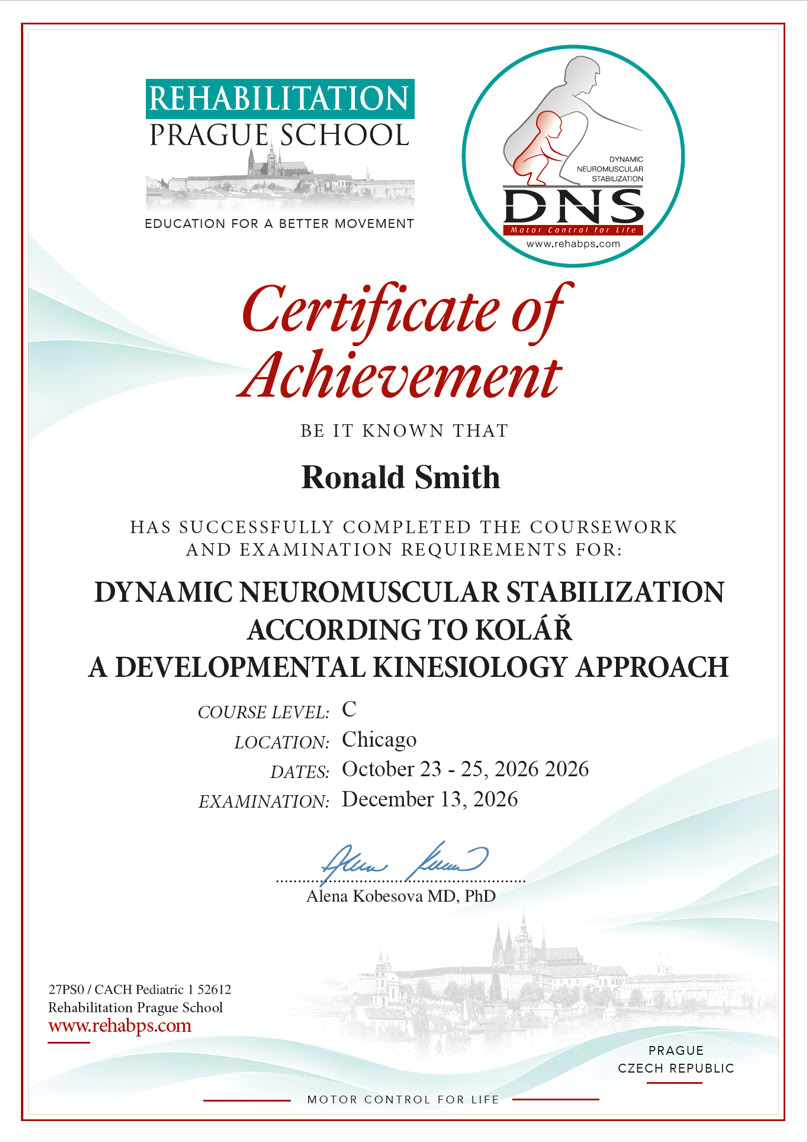
The test will consist of an analysis of adult patients. A link to view the videos will be sent to participant for analysis. Participants are advised to return the test to the DNS instructor within 2 months after the course. Upon successful completion and passing of the test, a Certificate of ACHIEVEMENT from Prague School of Rehabilitation will be awarded.
May only re-take the test 3 times.
Otherwise, the clinician would be required to repeat one or more courses, before re-qualifying for certification testing.