
Structure of the courses D
Course D: 6 day course (36 hours)
Location: Prague, Czech Republic
Eligibility requirements for the DNS Course D include:
Eligible applicants will be invited by the Rehabilitation Prague School and must meet the following criteria to receive an invitation.
- Completion of A – C courses and at least two additional DNS workshops. The additional DNS workshops may include repeated A-C courses, DNS skills review sessions, DNS special workshops e.g sports performance, neurological disorders, pediatrics, etc.
- Receipt of Certificates of Achievement in Courses A, B & C
- Application for Course D must take place no earlier than two years and no later than five years, following completion of Course A.
Course Objectives
1. In-depth discussion of advanced DNS topics with Professor Kolar
- Apply DNS across various medical fields such as musculoskeletal, orthopaedics, neurology, paediatrics, internal medicine, and gynaecology.
- Explore concepts of ideal motor function, advanced case assessments, and live treatment demonstrations.
- Provide insight into clinical findings and the rationale behind the techniques used.
2. Review
- Developmental position, kinesiology content, transition movements, assessment in dynamic tests.
- Anticipatory motion – a powerful tool for enhancing treatment and evaluating the accuracy of the therapist's approach
3. Mobilization techniques
- Implement developmental kinesiology principles to the cervical, thoracic, lumbar spine, and rib mobilization
4. Pelvic floor and women’s health
- Understand pelvic floor development and its functional linkage with diaphragm and abdominal wall.
- Identify common postural disturbances, joint dysfunctions, and hypersensitive zones in gynecological conditions.
- Apply DNS strategies in treatment of: stress incontinence, anorectal dysfunction, amenorrhea/dysmenorrhea, functional sterility, pelvic organ prolapse, pelvic pain syndromes, and pregnancy-related changes.
5. Specificity of DNS principles in athletic performance
- Enhance of performance with DNS principles in athletic populations, with a focus for assessment of dynamic parameters in global movement patterns.
6. Active exercise and stretching in developmental positions
- Utilize range of motion in spine, shoulder and hip – practical workshop.
7. Foot
- Functional assessment and treatment strategies tailored to different podiatric dysfunctions.
8. Upper extremity dysfunctions
- Review of kinesiology pf shoulder, elbow, wrist and hand, functional interconnection of upper extremity joints, including practical workshop targeting supporting and grasping functions of UE improvement.
9. Live patient demonstrations
- Perform comprehensive patient assessments, develop individualized treatment plans, administer targeted interventions and exercises, and determine appropriate care frequency and prognosis.
10. Refinement of DNS manual skills
- Hands-on workshops in small groups, including practicums with and without patients.
11. Practical examination on the final day.
Course goals:
- Integrate the full set of DNS principles into clinical reasoning and motor analysis
Master the synthesis of knowledge from previous modules and apply it coherently in both diagnostics and therapy. - Master the DNS verticalization sequence and smooth transitions between developmental positions
Guide the patient precisely from low-load positions to functional standing, with emphasis on continuity and complexity of global movement patterns. - Refine DNS testing and structure assessment according to clinical goals
Efficiently select appropriate undifferentiated and differentiated tests and design precise therapeutic strategies based on the TEST–THERAPY–RETEST model. - Apply DNS to specific clinical populations
Use DNS principles in pelvic floor dysfunction, Developmental Coordination Disorder (DCD), developmental dyspraxia, and in school-age children, including group-based approaches (e.g., DNS FIT KID demonstration). - Develop the ability to guide movement through maximal yet centered range and understand DNS application in sports
Optimize joint mechanics and stabilization during demanding movement tasks and understand the impact of motor strategies on athletic performance.
Course Program Overview:
(Sequence and specific content may vary for each Course D)
Day 1:
Registration:
1.block: Alena Kobesová: Registration and welcome, participant’s introduction. Prof. Pavel Kolář: DNS summary and update
Break
2. block: Prof. Pavel Kolář: Diagnostic approach based on assessment of postural and locomotion function. Patient demo
Lunch
3.block: Summary of DNS assessment - Diagnostic considerations
Break
4.block: Dynamic DNS tests/transitional phases, muscle synergies in IPSI, CONTRALATERAL patterns
Day 2:
1.block: Foot assessment and treatment
Break
2.block: Foot and lower limb workshop, transitional positions
Lunch
3.block: Refining DNS exercise skills – higher positions
Break
4.block: NEWS in DNS research. Group exercise – FIT KID modification
Day 3:
1.block: Elbow, wrist and palm
Break
2.block: Workshop upper limb, transitional positions
Lunch
3.block: Pelvic floor dysfunctions - practical workshop
Break
4.block: Patient demonstration: functional assessment and treatment with musculoskeletal/ pelvic floor problems. Group exercise
Day 4:
1.block: Performance enhancement in the athletic population: Contra and ipsilateral patterns in athletic performance
Break
2.block: Refining DNS exercise skills - workshop with sports equipment
Lunch
3.block: Refining DNS exercise skills, developmental flow
Break
4.block: Strength training in DNS – introduction into specific application of DNS
Day 5:
1.block: DNS based manual techniques
Break
2.block: DNS based manual techniques
Lunch
3.block: Mobilization techniques - ribs and related muscle chains, manual techniques and stretching in functionally centrated positions
Break
4.block: Manual techniques and stretching in functionally centrated positions
Day 6:
1.block: Dynamic DNS FLOW Break
2.+ 3.block: Practical DNS exam
Break
Parallel program
2.block: Refining of skills in high DNS positions
Lunch
3.block: Cortical functions testing – practical workshop
Patient demonstration: functional assessment and treatment with neurological problems
4.block: Discussion, Conclusions, Q&A
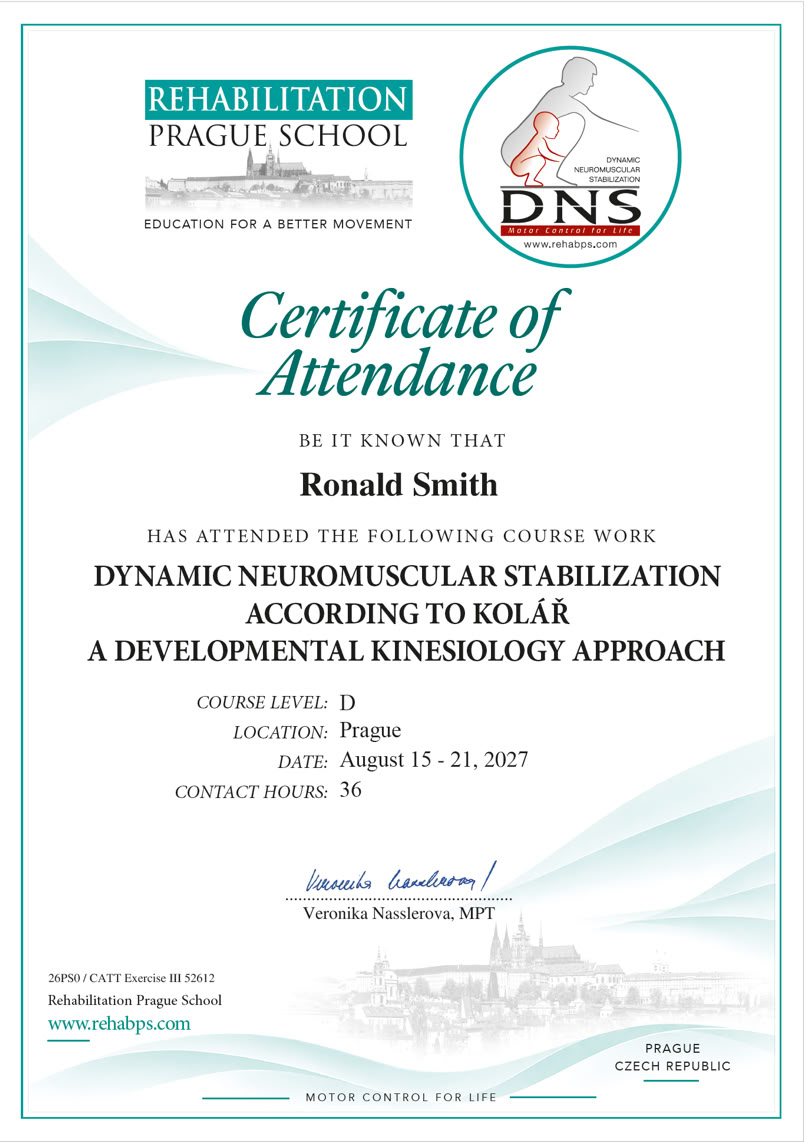
A Certificate of ATTENDANCE will be awarded by Prague School of Rehabilitation
EXAMINATION to Become a CERTIFIED DNS PRACTITIONER
The certification exam to become a DNS Practitioner consists of two parts: a multiple-choice online test and a practical examination.
Online multiple-choice test: Fee 65 Euros
Important: The written exam must be completed prior to attending Course D in Prague.
Participants have three attempts to pass the online written exam, which must be completed before attending Course D in Prague, where the practical examination takes place.
If a participant does not pass the written exam within three attempts, they will be required to postpone their attendance at Course D. In such cases, they must first repeat Course C or attend another DNS course before they can register for Course D in Prague again.
▶︎ The practical exam conducted at the end of Course D, is included in the Course D tuition. If the participant does not successfully pass the practical exam, they may register for Course D again the following year and attempt the practical exam once more. In the meantime, it is recommended that the participant attend at least one additional DNS course to improve their practical skills in DNS assessment and therapy.
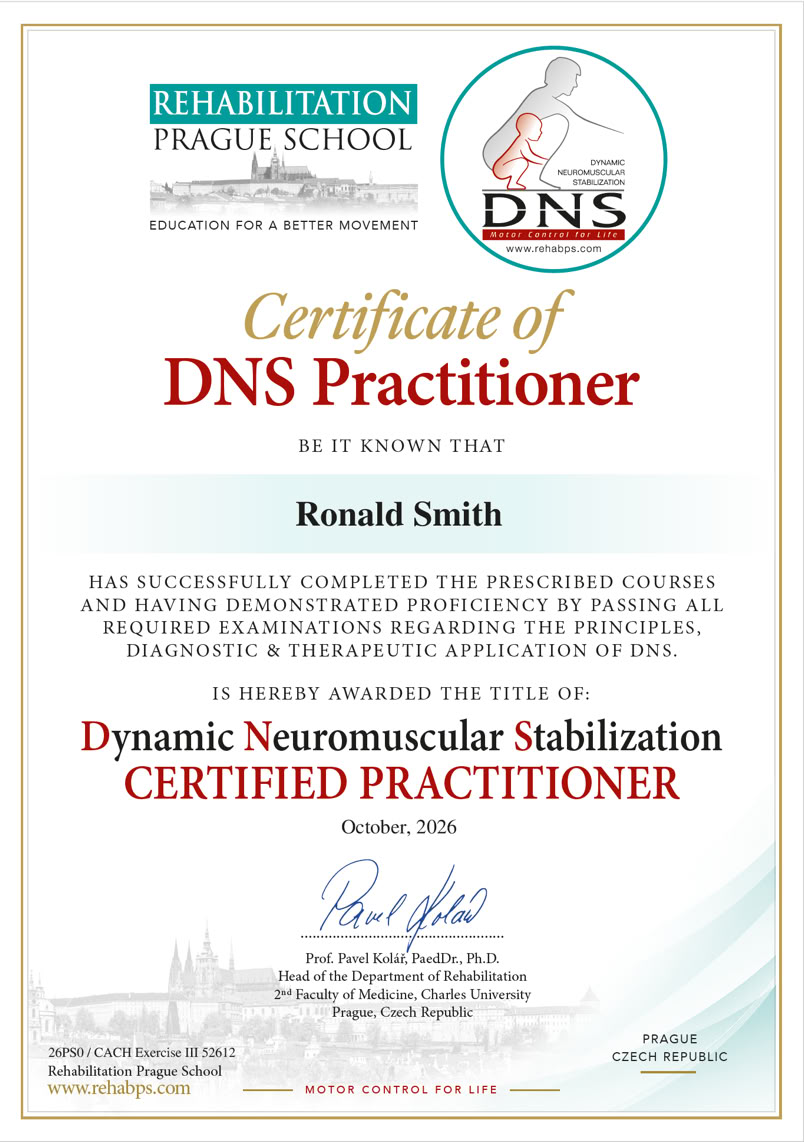
Upon successful completion of Course D and both exams, participants will receive a Certificate of DNS Practitioner from the Prague School of Rehabilitation.
They will be officially recognized as Certified Practitioners in the Dynamic Neuromuscular Stabilization (DNS) approach.
Advantages of being a Certified DNS Practitioner
- When you earn your certification, you can choose to have your name listed on the Prague School Rehabilitation website for a one-time fee of 20 Euros. You are required to take at least 1 DNS course every 3 years to retain your certification status.
- Updated information or articles/research pertaining to DNS
- Advanced practice sessions with Prague physiotherapists
- Special advanced courses with Professor Kolar and/or Prague PTs.
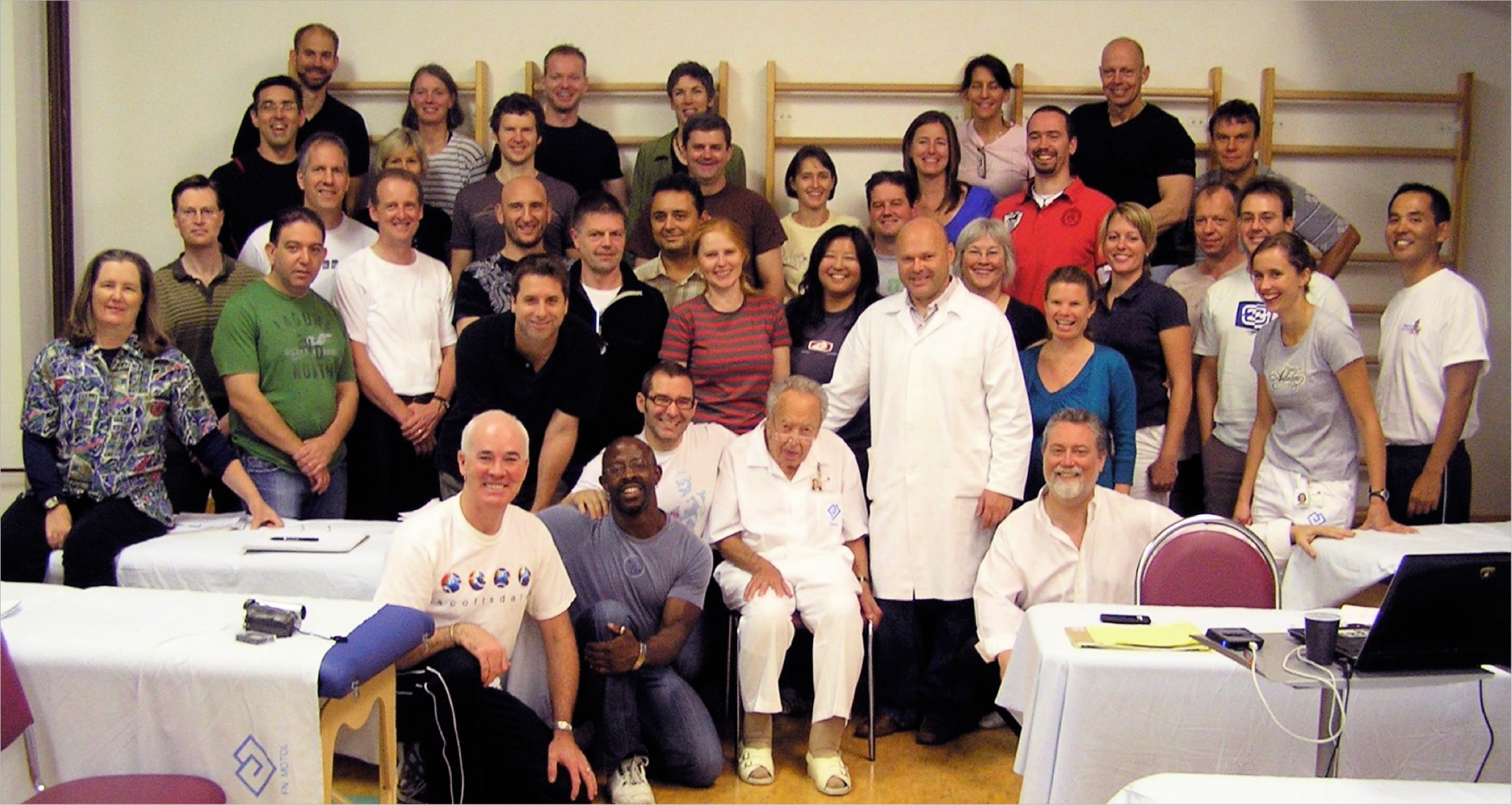
Prague, September 2009: First DNS course D


